 EasyToolHub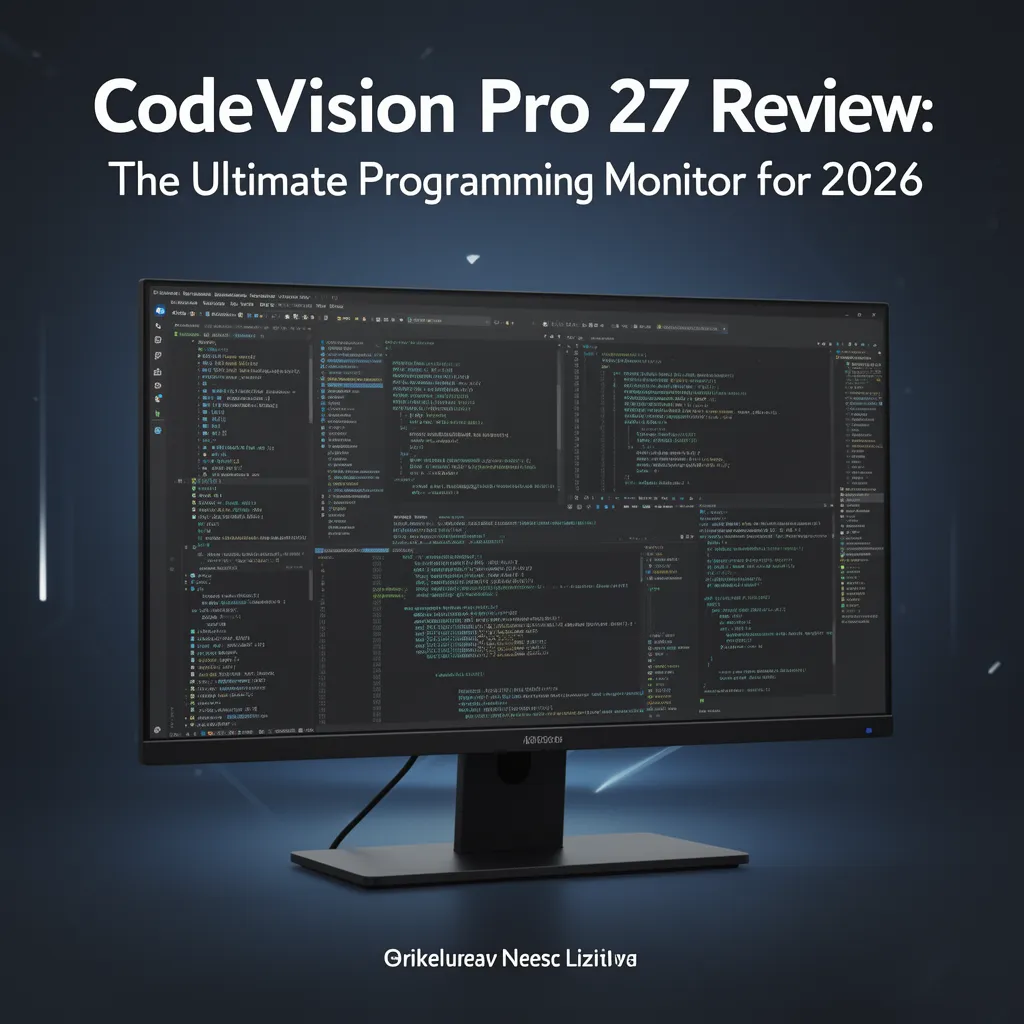
The Developer’s New Best Friend?
As development environments grow more complex, the humble monitor has evolved into a full-fledged productivity hub. The CodeVision Pro 27 arrives in 2026 promising to be exactly that—a purpose-built tool for programmers who spend 10+ hours staring at lines of code. After three weeks of daily use across TypeScript, Rust, and countless pull requests, here’s how it holds up.
Design & Ergonomics
Straight out of the box, the CodeVision Pro 27 impresses with a matte charcoal finish and a surprisingly compact base that doesn’t swallow your desk. The stand offers 150mm of height adjustment, tilt, swivel, and pivot—a must for pairing with a secondary vertical monitor. A small LED strip on the back glows a soft warm white, reducing eye strain in dark rooms without distracting. Cable management is thoughtful: a clip on the arm keeps everything routed cleanly. Build quality feels premium, with no wobble even during rapid typing sessions.
Display & Resolution
This 27-inch IPS Black panel delivers a crisp 3840 x 2160 resolution, meaning text is pin-sharp at 163 PPI. Programming fonts like JetBrains Mono and Fira Code look stunning with no visible pixelation even when sitting 18 inches away. The 120 Hz refresh rate may seem overkill for code, but scrolling through lengthy logs and switching between virtual desktops feels buttery smooth. Color accuracy covers 98% DCI-P3, which is overkill for terminal work but a welcome bonus when you jump into light design tasks. An ambient light sensor automatically adjusts brightness and color temperature throughout the day—fantastic for long coding stretches.
Connectivity & Built-in KVM
One feature that sets the CodeVision apart is its integrated KVM switch. You can connect a desktop via USB-C (with 90W power delivery) and a MacBook Pro through Thunderbolt 4, then share a single keyboard and mouse between them. Switching takes a second using the physical button or a hotkey. The monitor also includes two USB-A ports, one USB-C downstream, and an Ethernet jack. It effectively eliminates a separate dock from your desk.
Eye Comfort & Productivity Extras
Low blue light and flicker-free certification are table stakes, but CodeVision adds a “Focus Mode” that dims everything outside the active window—surprisingly useful when drafting documentation. The on-screen display offers presets for dark theme IDEs, light-themed documentation pages, and even terminal-only workflows. A dedicated “coding” mode increases contrast for black text on white backgrounds without messing with color accuracy.
Comparison: CodeVision Pro 27 vs. Dell UltraSharp U2723QE
The Dell UltraSharp U2723QE has long been the gold standard for programmers with its IPS Black panel and excellent connectivity. The CodeVision matches it in contrast and sharpness but pulls ahead with the built-in KVM, 120 Hz refresh rate, and ambient light sensor. Dell’s stand is slightly more ergonomic, but the CodeVision’s software extras make it feel more tailor-made for developers. At $650, it’s $50 more than the Dell, but the KVM alone justifies the premium.
Verdict
The CodeVision Pro 27 isn’t just another 4K display—it’s a productivity ecosystem. The built-in KVM, ambient light sensor, and coding-focused presets genuinely reduce friction in a multi-machine workflow. It’s the monitor I’d recommend to any programmer looking to declutter their desk and invest in long-term eye comfort. A true workhorse built for the age of remote development.